
Disclosure: this page contains affiliate links. We may earn a commission if you buy through them, at no extra cost to you.
Few household services are used as often, or noticed as little when they work, as home broadband. It carries the video calls, the streaming, the online shopping and the smart devices, so the provider you choose affects daily life more than most people expect. youfibre is a UK-based full-fibre broadband provider that has built its appeal on a simple idea: fixed monthly pricing with no mid-contract price change to catch you out. It has also recently integrated the broadband provider Brsk into its network coverage, which is a notable development for anyone watching how the UK's full-fibre market is consolidating. In this review, CompareBest looks at what youfibre offers, how it compares in general terms with other kinds of broadband provider, where it stands out, where it may not suit you, and how to decide whether it belongs on your shortlist. We stick to what is known about the brand and point you to the official site wherever details vary by address or offer.
The table below places youfibre alongside the broad types of broadband provider you are likely to be weighing up. The comparisons are deliberately general, because specific plans, speeds and prices change and depend on your address. Always confirm current details on the official site before you decide.
| Factor | youfibre | Large national providers | Other full-fibre challengers | 4G/5G home broadband |
|---|---|---|---|---|
| Network type | UK-based full-fibre broadband | Often a mix of technologies, depending on the area | Typically full fibre, in selected areas | Mobile signal rather than a fixed line |
| Pricing model | Fixed monthly pricing with no mid-contract price change | Varies by provider; check how in-contract changes are handled | Varies; some emphasise simple pricing | Varies; often a rolling or short-term style of plan |
| Subscription style | Monthly subscription; term details vary, so check the official site | Monthly subscription, usually with a minimum term | Monthly subscription, terms vary | Monthly subscription, often more flexible |
| Availability | Depends on your address; coverage now includes Brsk's network | Widely available, though the technology varies | Limited to where each has built | Depends on mobile signal at your home |
| Best for | Households wanting predictable bills on a full-fibre connection | People who want a familiar name and bundled extras | People in areas served by a specific local network | Renters or anyone who cannot get a fixed line |
| Price tier | Varies by plan; check the official site | Spans budget to premium | Often mid-range, varies | Varies widely |

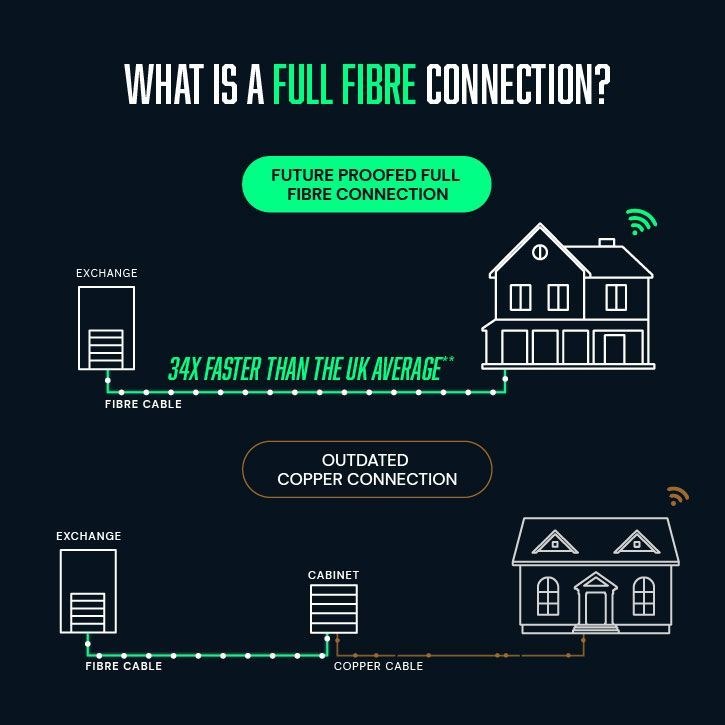
youfibre is a UK-based full-fibre broadband provider. Full fibre means the connection uses fibre-optic cable running all the way to the home, rather than relying on older copper wiring for the final stretch. That distinction matters because the last part of the connection is often where performance and reliability are won or lost. A provider focused on full fibre is making a clear statement about the technology it wants to deliver.
The brand's headline commitment is fixed monthly pricing with no mid-contract price change. In a market where many households have been caught out by increases partway through an agreement, a straightforward promise that your monthly cost stays the same for the agreed period is easy to understand and easy to value.
The other recent development is the integration of Brsk into youfibre's network coverage. Brsk is another broadband provider, and bringing it into the youfibre network broadens the footprint the brand can speak about. We do not know every detail of how that works at street level, and coverage depends on your exact address, so the sensible step is to run an availability check on the official site rather than assume.
Plenty of providers promise fast, reliable internet. What separates one from another is usually the shape of the commitment: what technology is used, how the bill behaves over time, and how much effort the customer has to put in to stay on a fair deal. Here is where youfibre makes its case.
The clearest differentiator is the fixed monthly pricing with no mid-contract price change. Household budgeting is easier when a recurring cost is predictable. If you know your broadband bill will not move for the length of your agreement, you can set up a standing order, forecast your year and stop wondering whether an unexpected increase is coming.
This matters most for people on tight or carefully planned budgets, for shared households where the bill is split between several people, and for anyone who simply dislikes surprises. It also makes comparing offers more honest. When a price can rise during the term, the advertised figure only tells part of the story. A fixed price is closer to the whole story, although you should still check the length of the agreement and any one-off costs on the official site.
youfibre is a full-fibre provider, so its identity is tied to one technology rather than a patchwork. For the customer, that tends to mean a simpler proposition: if your address is covered, you are being offered a fibre connection to the property rather than a decision between several different technologies. We will not quote speeds, because plans and speeds vary and the official site is the right place to check what is offered at your address. But the full-fibre approach is the sort of infrastructure that suits modern households with many connected devices competing for bandwidth at the same time.
Broadband is a coverage game. A provider can have a great proposition, but if it does not reach your street, it is irrelevant to you. The recent integration of Brsk into youfibre's network coverage is therefore worth paying attention to. It signals a provider that is expanding its reach rather than standing still. For readers, the practical consequence is straightforward: if you previously checked youfibre and found nothing at your address, or if you know Brsk as a name in your area, it may be worth checking again. We cannot tell you exactly which postcodes are affected, and it would be wrong to guess, so use the official availability checker.
Some brands compete by stacking on extras: bundled television, mobile deals, loyalty tiers and promotional periods that expire. youfibre's public message is more focused, centring on full-fibre broadband and a price that does not move. For people who want internet that works and a bill that stays put, that focus is a point in its favour. If you want a large bundle of additional services under one roof, you may find a bigger provider a better fit, and we cover that in the section on who it suits.
It is worth being precise about what a fixed monthly price does and does not promise, because the phrase is easy to over-read.
A fixed monthly price, with no mid-contract price change, means the amount you pay each month should not go up while you are within your agreed term. It is a statement about stability during the contract. It does not tell you what the price will be, how long the term runs, or what happens when the term ends. Those details vary by plan and offer, so read them on the official site before you sign up.
Even if a fixed price is not the lowest on the market at a given moment, predictability has genuine worth. A slightly higher fixed bill that never changes can be preferable to a lower introductory bill that climbs. This is a subscription-model point rather than a headline-price point: you are paying for certainty. How much that certainty is worth to you is personal, but if you have ever been surprised by a broadband increase, you will understand the appeal.
A broadband review is only useful if it connects to how you actually live. Here are the situations where a full-fibre connection with a stable monthly price tends to make the most sense. We are describing the type of household, not promising particular performance, which depends on your plan and address.
If your job depends on video calls, cloud documents and remote access to company systems, your broadband is effectively your workplace infrastructure. Reliability matters more than anything else, because a dropped connection in the middle of a meeting costs you time and credibility. A full-fibre connection is the sort of line that suits this kind of use, and a fixed monthly price helps if you are budgeting for business-related costs or claiming a share of your home expenses where that applies to you.
In a busy home, a phone, tablet, laptop, games console, television and smart speaker can all be online at the same moment. The strain comes from many simultaneous demands rather than one big one. A modern fibre connection is designed with this pattern in mind. Family budgets also benefit from fixed pricing, as it removes one variable from the monthly household spend.
Streaming high-quality video and playing online games both reward a stable connection. Gamers in particular tend to care about consistency, since a connection that wobbles is more annoying than one that is simply a little slower. If this is you, pay attention to how you connect inside your home as well as to your plan, and see our tips section below on using a wired connection for your most important devices.
In a shared house, one bill often gets split among several people, and disputes tend to arise when the amount changes unexpectedly. A fixed monthly price makes splitting easier and fairer. The main caution is the agreement length: if tenancies are short, check the term and any early-exit conditions on the official site so you are not committed beyond the time you will live there.
Freelancers and very small businesses working from home often want predictable overheads. A fixed monthly cost is easier to include in a budget or forecast. If you need business-specific features such as guaranteed service levels or static addresses, check the official site to see what is available, as we cannot confirm those details here.
Smart speakers, cameras, thermostats and doorbells each use a modest amount of connectivity, but together they add up and are always on. A dependable full-fibre line gives that ecosystem a sturdier base. Again, the quality of your in-home wifi will shape the experience as much as the line coming into the house.
Before you commit to youfibre, or any provider, work through this list. It is designed to turn a vague preference into a confident decision.
A good line into your home is only half of the story. How you set up and use the connection inside the house determines how good it feels day to day. These tips apply to full-fibre broadband in general and are not specific claims about any particular youfibre product.
Place the router in a central, open position, ideally off the floor and away from thick walls, large metal objects and other electronics that can interfere. Tucking it in a cupboard or behind a television is one of the most common reasons people feel their broadband is slower than it should be. Because the equipment is often supplied with the service, check on the official site what you receive and whether you can use your own.
Wifi is convenient, but a wired ethernet connection is generally more stable. If you have a desktop computer, a games console or a streaming box that stays in one place, plugging it in with a cable can remove a layer of variability. This is especially worthwhile for work video calls and competitive gaming.
If you want to check how things are going, run a speed test using a wired device close to the router, at different times of day. Do it a few times rather than once, since a single result can mislead. If results are consistently well below what you expect from your plan, note the details and contact support with your findings rather than a vague complaint.
Old devices, heavy background updates and cloud backups can quietly consume bandwidth. Schedule large downloads and backups for times when nobody needs the connection for calls or streaming. Review which devices are connected to your wifi and remove ones you no longer use.
Change default passwords on your router, use a strong wifi password, and keep firmware up to date where the equipment allows it. Good security protects both your data and your bandwidth.
If you have a larger home with weak spots, consider a mesh system or wired access points rather than cheap plug-in boosters that can reduce performance. A strong line can still feel disappointing if the wifi does not reach the rooms you use. Check whether the provider offers or supports any extender options, as availability varies.
Your needs change. A new job, a growing family or a house full of new devices might justify a different plan. Because youfibre's pricing is fixed during the agreement, the natural moment to review is as your term nears its end. Make a note in your calendar so you can check the official site for current options before then.
youfibre is most likely to suit you if:
You may want to look elsewhere if:
If you are somewhere in the middle, the best approach is to check availability, read the terms and compare against one or two alternatives in your price tier. The decision is much easier once you can see the actual offer for your address.
youfibre is a UK-based full-fibre broadband provider. Its main selling point is fixed monthly pricing with no mid-contract price change. It has also recently integrated the broadband provider Brsk into its network coverage.
It means the amount you pay each month should stay the same during your agreed term, without a mid-contract change. The exact price, term length and conditions vary by plan, so check the official site for current details before signing up.
Full-fibre broadband uses fibre-optic cabling all the way to your home, instead of using older copper lines for the final part of the connection. This is the type of infrastructure youfibre focuses on. Whether it is available at your property depends on your address.
youfibre has recently integrated Brsk into its network coverage, which broadens the footprint it can offer. The specifics for any given street or postcode vary, so the best way to find out what it means for you is to run an address check on the official site.
Use the availability checker on the official site and enter your full address. Coverage is specific to location, so a neighbouring street could differ. If it is not available now, it may be worth checking again later, as coverage can change.
Pricing varies by plan and over time, so we do not quote figures here. What we can say is that youfibre's pricing is fixed monthly with no mid-contract price change. Check the official site for the current price, term length and any one-off costs that apply.
A full-fibre connection suits these uses in general, because they reward a stable line. The actual experience depends on your plan, your address and how you set up your home network. Using a wired connection for key devices and positioning your router well will help, whichever provider you choose.
Check availability at your address, the length of the agreement, what happens at the end of the term, any installation or set-up costs, and whether you face early termination charges with your current provider. Try to line up the switch so you are not left without service, especially if you rely on your connection for work.
youfibre makes a clear and appealing case. It is a UK-based full-fibre broadband provider offering fixed monthly pricing with no mid-contract price change, and it has recently expanded its network coverage by integrating Brsk. For households that value a predictable bill and a modern fibre connection, that combination is attractive. It will not be the right fit for everyone: availability depends on your address, details vary, and anyone wanting a large bundle of extras or chasing the lowest short-term price may prefer another route.
The sensible next step is simple. Check whether service is available where you live, read the current plan details and terms, and weigh them against the checklist above. When you are ready, visit youfibre's official site to check availability at your address and see the latest plans and terms.